
Ynys Enlli was among the many remote places of the west and north-west coasts of Britain and Ireland to be settled between around 500 and 1000 AD. During those centuries, an extraordinary migration occurred. Monks, anchorites, solitaries, and other devout itinerants began to travel in their thousands to the bays, forests, promontories, mountain-tops and islands of the Atlantic littoral. In frail craft and with little experience of seamanship, they sailed out across dangerous seas, in search of something we might now call wilderness. Where they stopped, they built monasteries, cells, and oratories, dug cemeteries for their dead, and raised stone crosses to their God. These travellers were known as peregrini: the name derives from the Latin peregrinus, and carries the idea of wandering over a distance, and gives us our word ‘pilgrim’. Before coming to Enlli, I had plotted on a map the known routes and landfalls of these migrations, and I had ended up with a tracery-work of what are still among the wildest parts of Britain and Ireland.
This Celtic Christian culture of retreat originated in the Ireland of the fifth and sixth centuries. Begun by St Patrick in the 430s, and inspired by the desert saints of the preceding centuries, the practice of retreat spread to what are now western Scotland and coastal Wales: a centrifugal motion, carrying men to the brinks of Europe and beyond.
It is clear that these edgelands reciprocated the serenity and the asceticism of the peregrini. Their travels to these wild places reflected their longing to achieve correspondence between belief and place, between inner and outer landscapes. We can surmise that the monks moved outwards because they wished to leave behind inhabited land: land in which every feature was named. Almost all Celtic place-names are commemorative: the bardic schools, as late as the seventeenth century, taught the history of places through their names, so that the landscape became a theatre of memory, continually reminding its inhabitants of attachment and belonging. To migrate away from the named places (territories whose topography was continuous with memory and community), to the coasts (the unmapped islands, the anonymous forests), was to reach land that did not bear the marks of occupation. It was to act out a movement from history to eternity.
From the early years of Celtic Christianity, Ynys Enlli was renowned as a destination for the peregrini, and the first monastery is thought to have been built there in the sixth century. For all its difficulty of access, however, it is among the least remote of the monks’ habitations. You wonder at how the monks reached and settled landscapes such as the Garvellochs – the islands off the Argyll mainland where, over a thousand years ago, people lived in clustered mortarless huts shaped like beehives – or Skellig Michael, the rock fang that juts seven hundred feet out of the Atlantic, nine miles west of the Kerry coast. The uppermost slopes of Skellig Michael are riddled with cells, hewn out of the rock by the monks who landed there in the sixth century. The cells, which were used for penance and meditation, face out onto the Atlantic. Below them, the rock swoops away so abruptly and steeply that it is hard to believe you are even on land, and not hovering above only air and sea. There, with the ocean extending away from them, and nothing on the horizon to abbreviate or delay the eye, the monks were free to consider infinitude.
George Bernard Shaw travelled to the Skelligs in September 1910 in a clinker-built rowboat. The journey out took two-and-a-half hours in calm weather; the way back was longer and more unnerving. Rowing in thick mist and darkness, compassless and moonless, over tide-races and currents, Shaw’s guides steered by instinct and knowledge alone. The following evening, sitting by the fire in the Parknasilla Hotel in Sneem, Shaw wrote a letter to his friend Barry Jackson about his experience on Skellig Michael. ‘I tell you the thing does not belong to any world that you and I have lived and worked in: it is part of our dream world…. I hardly feel real again yet!’ For Shaw, as for the monks who once lived there, on the Skellig you were brought to think in ways that would be possible nowhere else. It was a place for deep dreaming.
The sea-journeys that the peregrini made are extraordinary to contemplate. We had difficulties reaching Ynys Enlli in a thirty-three-foot ocean-going yacht. Shaw had feared for his life returning from the Skelligs in a well-manned rowboat. Yet the monks had got to the Skelligs, and had made longer, riskier voyages – to Iceland and to Greenland, over the rough seas of the North Atlantic – in far more exposed and unstable craft.
The boats in which they travelled went by different names in different traditions: the coracle or curricle in Wales, the carragh in Gaelic, the knarr in Norse. Their shapes differed, too – the curragh was generally long and thin, with a snub nose and squared-off bows, while the coracle was lenticular. What they shared was a method of construction. Their hulls were of ox-hide, which was oak-tanned, then wetted and stretched over a framework of bent wood and wicker. As it dried, the hide shrank around the framework, setting it rigid. Once it had set, it was caulked with tallow. What these craft had in common a logic of motion.
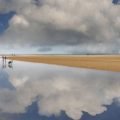
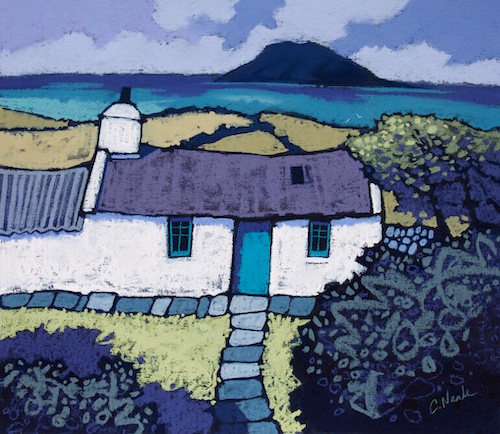
[Image of Ynis Enlli by Chris Neale]