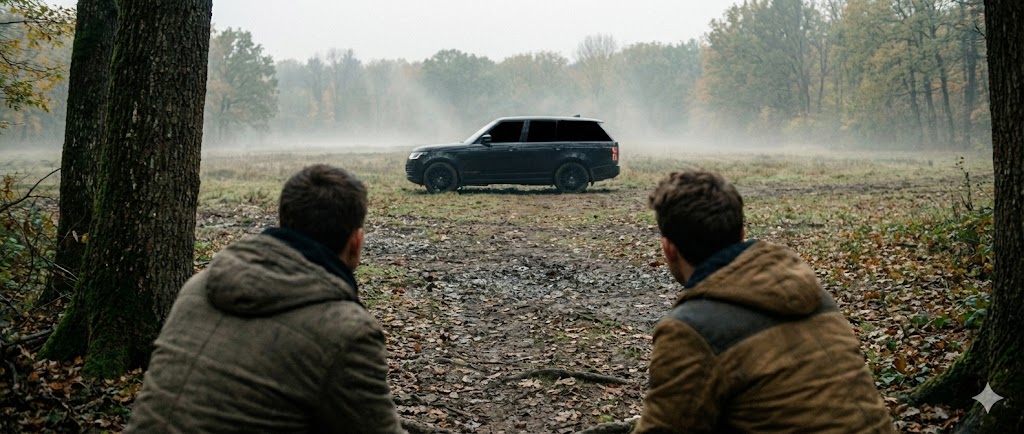

He and Ödon wait in the cold wood. It’s a winter afternoon and under the trees it’s already quite dark as they stand next to the car smoking cigarettes.
“Who’re we waiting for?” István asks.
“Just some guys,” Ödön says.
“Are we in Croatia?” István asks, a minute later.
Ödön shrugs.
“It’s fucking cold,” István says, a few minutes later.
“Yeah,” Ödön agrees.
After a while another car comes along the track, from the opposite direction. It’s a small Suzuki jeep with Croatian plates.
“Wait here,” Ödön says. “Keep your eyes open.”
He walks toward the jeep, which has stopped.
Two men get out and they talk. They seem to be speaking English but they talk in quiet voices and István can’t hear what they’re saying.
He can’t see them very well either in the dusky light.
He just stands there, with his hands in his pockets, feeling cold.
His feet, especially, feel very cold.
He’s wearing the wrong sort of shoes.
He looks down at them, and at the half-frozen mud of the track.
About a week ago he ran into Ödön in the town. He knew him slightly from the young offenders’ institution. Ödön seemed pleased to see him and asked did he want to earn some money. István asked him what he meant. Ödön explained that he had to pick up some stuff in Croatia and needed someone to go with him.
“Why?” István asked.
“To watch my back.”
“What stuff?” István asked.
“Whatever. That’s not important.”
“Why do you need someone to watch your back?”
“So that I feel safe.”
“Why wouldn’t you feel safe?”
“I’d feel safer with someone like you with me.”
“What do you mean, someone like me?”
“You know what I mean,” Ödön said.
And it’s true that István had made a sort of name for himself in the institution. Like everyone in there he had to fend for himself. There were some fights. He had an aptitude for fighting, he discovered. The fact that he was in there for killing someone helped. It made him kind of fearsome to some of the others. It made it easy, once he worked out how to do it, to intimidate people.
That’s probably what Ödön was talking about.
When he told István how much he would pay him, István said he would do it.
And now he’s here, in the cold wood, hugging himself and trying to hear what Ödön is saying to those two men about fifty meters away in the half-darkness under the trees.
Ödön comes back with a bag, a sort of nylon sports holdall. He puts it in the car and then reverses along the track, the way they came.
“What is it?” István asks, blowing into his hands. “Drugs?”
“Whatever,” Ödön mutters. He’s twisted around in his seat, reversing along the track, which is too narrow for him to turn in.
It’s nearly dark now.
When they reach the main road—which is itself just a quiet, two-lane thing without any traffic—he puts the headlights on.
They drive back to the town and then to a part of it that István doesn’t know very well. A few years ago it was mostly vineyards and fields. Now there are more and more houses on the hillside. They stop at one of them and István waits in the car while Ödön rings the doorbell.
“Who lives there?” István asks him, when he returns without the holdall.
“I don’t know,” Ödön says.
He pays István his money and drives him home.
They do the same thing a few more times that winter, and for a while István has money.
He mostly spends it on going out, although the town’s nightlife is very limited. The main place is Jungle.
Sometimes he sees Ödön there. On one such occasion, when he’s drunk, Ödön tells him that he thinks it’s heroin in the bags they pick up. He says that one of the main heroin routes into Europe is through the Balkans, and that this might be part of it.
After they’ve had a few drinks they talk about taking one of the bags and selling the stuff themselves, if it is heroin.
They never do that, though.
They never even look in the bags.
They’re too scared of the man in the house, and also they’re satisfied with the money he pays them for delivering the stuff to him, whatever it is. It seems like a lot to them.
Then Ödön suddenly disappears and István is poor again.